Let's be honest. A leaky snorkel mask ruins everything. That constant trickle of cold water on your face, the fogged-up lenses, the frantic surface adjustments while everyone else is watching turtles. I've been there. After a decade of guiding trips and testing gear, I can tell you that 90% of mask problems aren't about the mask's quality—they're about the fit. This guide cuts through the generic advice. We're going to find you a mask that seals like it was molded for your face.
What You'll Learn in This Guide
How to Choose the Right Snorkeling Mask for Your Face Shape
Forget brand names for a second. The first thing to look at is the shape of the mask's skirt—the soft silicone part that seals against your skin—and the frame. Most shops will just hand you a "popular" model. Bad move.
Your face isn't generic. I've seen people with wide cheekbones struggle with narrow European masks, and folks with low nose bridges have the skirt cut right across their eyes. Here’s what most snorkel shops won’t tell you.
Pro Insight: The single most overlooked fitting zone is the brow and nose bridge area. If the mask frame presses into your brow bone or the silicone doesn't smoothly cup the sides of your nose, you'll get a top leak every time. This is more common than you think.
Face Shape & Mask Type Matching
| Your Face Feature | What to Look For in a Mask | What to Avoid |
|---|---|---|
| Wide Face / High Cheekbones | A low-volume mask with a wide skirt. Look for models specifically labeled "wide" or "Asian fit." The skirt should cover from temple to temple without stretching. | Tall, narrow masks. They'll leave gaps at your temples. |
| Narrow or Long Face | A standard or narrower skirt. Many mainstream European brands cater to this. The key is the seal along the cheeks—it shouldn't buckle or have excess material. | Extra-wide skirts. They'll crease and leak. |
| Low Nose Bridge (Common in many Asian ethnicities) | Masks with a low nose pocket or a split/flexible bridge. The skirt should sit below the bony part of your nose, not on it. | Masks with a high, rigid nose pocket. It will sit on bone, not skin, breaking the seal. |
| Prominent Brow Ridge | A deeper skirt or a frame with a cut-out/curve to accommodate the brow. The skirt material needs to be soft and pliable here. | Flat-fronted masks. The frame will dig in, causing pain and a leak channel. |
| Wide-Set Eyes | Pay attention to the lens distance. The lenses should align with your eyes without you feeling like you're looking through tunnels. Some masks offer different lens spacing. | Masks where your peripheral vision is blocked by the frame between the lenses. |
I learned this the hard way on a trip to Fiji. I brought my favorite "high-end" mask, but it was designed for a different facial structure. Two days of constant leaking later, I borrowed a guide's simpler, wider model. Problem vanished. The price tag doesn't matter if the geometry is wrong.
The 3-Step Snorkeling Mask Fit Test (Do This Before You Buy)
You can't tell if a mask fits by holding it up. You have to test it. Do this in the store, every single time. Ignore any strange looks.
Step 1: The Dry Fit (No Strap)
Push your hair back. Place the mask gently on your face. Do not use the strap yet. Let it sit there. Does it feel balanced? Is there pressure on your brow or nose? It should feel comfortable, not pinching. This checks the basic shape compatibility.
Step 2: The Suction Test (The Most Important Step)
With the mask still on your face and the strap dangling, inhale gently through your nose. Now hold your breath. The mask should suck onto your face and stay there by itself. Try to shake your head gently side to side. It should hold.
Critical Check: While the mask is suctioned, feel around the entire skirt with your fingers. Is it flush against your skin everywhere? Pay special attention to the tricky spots: the corners of your eyes, the sides of your nose bridge, and your temples. Any gap you feel is a future leak.
Step 3: The Strap & Movement Test
Now, put the strap over your head. It should be loose. Seriously. Snug it just enough so it doesn't fall off. Your face should not change shape. Open your mouth wide, make funny faces, frown. The mask seal should not break. If you have to crank the strap tight to hold the seal from Step 2, the mask doesn't fit. The strap's job is to keep the mask from falling off, not to create the seal. That's the skirt's job.
I've watched countless new snorkelers fail this test. They crank the straps so tight they get "mask face"—deep red rings around their eyes—and still complain about leaks. It's a vicious cycle.
Putting It On Correctly: A Ritual, Not a Chore
You've passed the test and bought the mask. Now, how you put it on matters more than you think.
- Get your hair out of the way. This sounds obvious, but a single strand under the skirt is a wick for water. Pull long hair into a low ponytail, not a high bun where hair can fall down.
- Position the strap correctly. It should sit across the widest part of the back of your head, not on the crown or on your neck. This pulls the mask frame straight back, not upward or downward.
- Defog like a pro. Spit works, but it's inconsistent. A tiny drop of baby shampoo or mild dish soap rubbed on the inside of the lenses, then given a very quick seawater rinse (leave a faint film), is unbeatable. Never use toothpaste—it can scratch coatings.
Fixing Leaks: Top, Bottom, and Side Leaks Solved
Even with a good fit, minor leaks happen. Here’s how to diagnose and fix them on the fly.
Leak from the TOP (forehead): This is almost always a strap issue. The top strap is too tight or positioned too high, pulling the frame up and lifting the skirt off your brow/nose bridge. Loosen the top strap and reposition it lower. Also, check for eyebrows or brow hair under the skirt.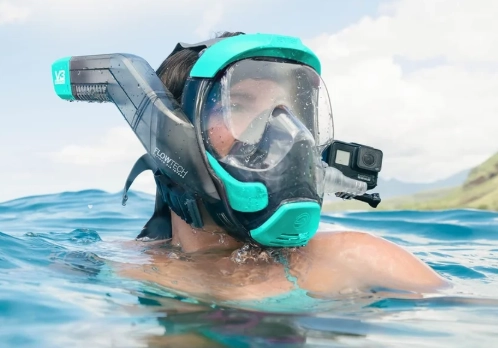
Leak from the BOTTOM (cheeks/upper lip): The strap might be too low on your head, pulling the mask down. Or, you're smiling or talking underwater, flexing your cheeks and breaking the seal. Try to relax your face. Tightening the strap here is the wrong fix—it'll just make it worse.
Leak from the SIDES (temples): This is often a hair issue or a sign the mask is too narrow for your face. Ensure no hair is caught. If it's persistent, you might need a wider model.
The Mustache Leak: For men with facial hair, the seal over the mustache area is tricky. Some apply a thin layer of silicone-based lubricant (like food-grade silicone grease) to the mustache to help the skirt seal. It's a niche trick, but it works.
Remember, a perfect fit feels almost effortless. If you're constantly fighting your mask, go back to the suction test. The ocean is distracting enough without battling your gear.
Your mask is your window to the underwater world. Taking the time to get the fit right isn't just about comfort—it's about safety and enjoyment. A leak-free mask means you're focused on the fish, not on the water in your nose. Now go test some masks.
Snorkeling Mask Fit: Your Questions Answered
My mask always leaks from the top near my forehead. What am I doing wrong?
How can I stop my snorkel mask from fogging up for an entire 2-hour session?
I wear glasses. Can I get a prescription snorkel mask that fits well, or should I use inserts?
How do I choose a snorkeling mask for a child with a small face?
Reader Comments